6.1

Our DNA

The nature and size of EFE is not always well known. For the sake of a better understanding of its activity and penetration in the information market, the agency has updated all its data available to the general public.

We are a public Agency accountable to Parliament, the Court of Auditors, the IGAE (General State Comptroller), and the European Commission. Internally, we adhere to a strict Code of Ethics and a protocol governing the collection and editing of information, under collegial decision-making processes.

This internal quality control is further endorsed by the Editorial Board, a professional representative body of the Agency’s journalists that oversees newsroom activities through a Statute approved on May 18, 2006, now 18 years in effect.

Agencia EFE upholds an unwavering commitment to compliance with current legislation across all areas of its operations. Its public service mission and focus on the common good guide its efforts toward building a more transparent, ethical, and responsible society by delivering rigorous, truthful, independent, and pluralistic information.

EFE also has a Compliance Committee, the body responsible for promoting a strong ethical culture through its advisory and supervisory role.

Key policies and procedures of its compliance system, approved by the Board of Directors, are available through the Agency’s Ethics Channel.

Code of Ethics

Sustainability Policy

Criminal Risk Prevention Manual (CRPM)

Anti-Corruption Policy

Rules governing the Ethical Channel, including the Policy and Procedure for managing the internal information system

Statute of the Compliance Committee

Suppliers’ Code of Ethics

Respect for legal principles and ethical values is strengthened by a culture of transparency and Good Governance, rejection of corruption, equal opportunities, defense of human rights, and professionalism in every action.

6.2

Caring for the Spanish Language

Agencia EFE maintains a fruitful collaboration with the two leading institutions dedicated to the stewardship and promotion of the Spanish language: the Royal Spanish Academy (RAE) and the Instituto Cervantes, in defense of proper language use in the media.

Five years ago, the Royal Spanish Academy (RAE) and Agencia EFE relaunched the Fundación del Español Urgente (Fundéu) to improve language usage in Spanish-language media, especially in Spain and the Americas, through the foundation now known as FundéuRAE.

The board of trustees of FundéuRAE is composed of RAE director Santiago Muñoz Machado (as president); the president of Agencia EFE, Miguel Ángel Oliver (vice president); the director of the Instituto Cervantes, Luis García Montero; academics José María Merino, Soledad Puértolas, Carme Riera; and journalist and writer Álex Grijelmo, the driving force behind Fundéu.

The director of FundéuRAE, Olivia Piquero, is also the Director of Communications at the RAE.

EFE, the RAE, and the Instituto Cervantes are “the three most fundamental institutions for managing and promoting the Spanish language—one linked to the media like no other in Spain, and the two leading institutions in the preservation and development of our language,” in the words of Muñoz Machado.

The Fundación del Español Urgente, FundéuRAE, also selects a Word of the Year annually. This word does not necessarily have to be a new term, but must spark linguistic interest due to its origin, formation, or usage, and have played a prominent role in the year of its selection. In 2024, the word of the year was Dana.

The foundation—promoted by the Royal Spanish Academy and Agencia EFE—chooses the word based on its impact in the media and social debate across the Spanish-speaking world. Although Dana was a candidate back in 2019 (without being selected), five years later it prevailed over eleven other highly present terms in the news and public discourse of 2024, including popular contenders such as Fango, woke, Inquiokupa, or Mena.

The Instituto Cervantes (IC) is a strategic ally for Agencia EFE in the defense of the Spanish language. With a presence in 86 centers across 45 countries on five continents, the IC shares headquarters with EFE in Rio de Janeiro and a shared mission: to promote and spread the Spanish language and culture around the world. Both institutions combine their efforts and capitalize on their respective strengths to work synergistically and collaborate in areas of shared interest. During 2024, the Instituto Cervantes designated its experts and locations in Madrid, Rabat, Beijing, and São Paulo to present the “New Urgent Stylebook” of Agencia EFE, thereby helping to promote proper language use in the media.

6.3

Stylebook

On January 3, 2024, Agencia EFE began the year by celebrating its 85th anniversary, a milestone marked with a solemn ceremony at the Instituto Cervantes (IC) in Madrid. At the end of January, in the Institute’s “Caja de las Letras” (Box of Letters), EFE deposited a legacy that highlights journalism as a cornerstone of culture and democracy.

The Instituto Cervantes’s vault, which preserves the secrets and symbols of writers and artists of Hispanic culture, now also safeguards EFE’s identity codes, including the basic standards and linguistic and ethical criteria by which EFE’s professionals have narrated world events day by day. It holds the style guides of the leading Spanish-language news agency and some of the most iconic photographs in Spain’s history, such as those captured by Manuel Barriopedro and Manuel Hernández de León during the attempted coup d’état of February 23, 1981.

During this event, EFE presented the New Urgent Stylebook, co-published with the Instituto Cervantes, under the executive coordination of EFE journalist Javier Lascuráin. It was explained that this manual is both new, as its title suggests, and old, as it inherits a long tradition of style texts from the agency, which was a pioneer in producing such works.

This living and practical legacy for society rewrites the Libro de estilo urgente (Urgent Stylebook) of 2011, coordinated by Emilio Crespo, former EFE Director of News and International. Crespo contributed to the ceremony by placing in the Instituto Cervantes’s vault a removable drive containing the digital archive “EFE hace historia” (EFE Makes History), which preserves the agency’s history online.

A limited number of printed copies of the New Urgent Stylebook have been produced and distributed to universities, institutions, public organizations, and the Instituto Cervantes libraries worldwide. The book compiles the ethical, professional, and linguistic standards that guide the journalistic work of Agencia EFE.

Beyond its internal utility, this work offers these guidelines to all professionals in other media, educators, and communication students who share EFE’s fundamental principles: rigor, clarity, and precision in information; contextualization, verification, honesty, and, of course, the utmost respect for the subjects of the news and the citizens to whom it is directed.

With its well-known commitment to public service, EFE made the digital version of this book freely available to everyone. Since early 2024, it has been accessible for download on its corporate website (www.agenciaefe.es), where it remains available.


International Presentation of the Style Guide

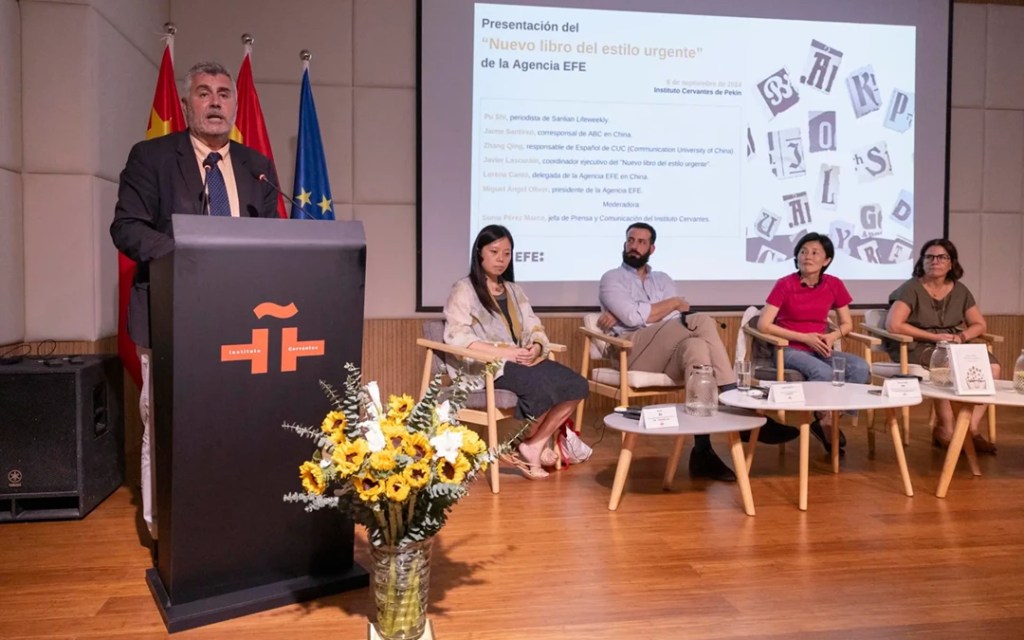
A few months later, the international presentation tour of this guide—designed to help journalists tackle the ethical and linguistic challenges of journalism in the digital age—began. The New Urgent Stylebook, which made stops at the Instituto Cervantes offices in Beijing (China), Rabat (Morocco), São Paulo (Brazil), and New Delhi (India), was presented by EFE President Miguel Ángel Oliver. The directors of the Instituto Cervantes joined him in each of these global locations, as well as the IC’s Head of Press and Communication, Sonia Pérez Marco.

The presentation in Beijing, held in September, was preceded by a roundtable titled “Beyond Information: The Challenges of Journalism 4.0”, where journalists and experts discussed the impact of new technologies on journalism.

In October 2024, the New Urgent Stylebook was presented in Rabat under the theme “The Debate on Immigration in the Media: When the Narrative Kills the Data.” The session addressed the need to humanize migrants’ stories, give them a voice without fueling controversy, and avoid demeaning language.

Two months later, the manual was presented at the Instituto Cervantes in São Paulo with the discussion “What’s Happening with Spanish in Brazil?” The event highlighted how the Spanish language is gaining ground in Brazil, despite certain political decisions that have led to a decrease in the number of Spanish-language students in the South American giant.

Social Environment

7

FINANCIAL
RESULTS