


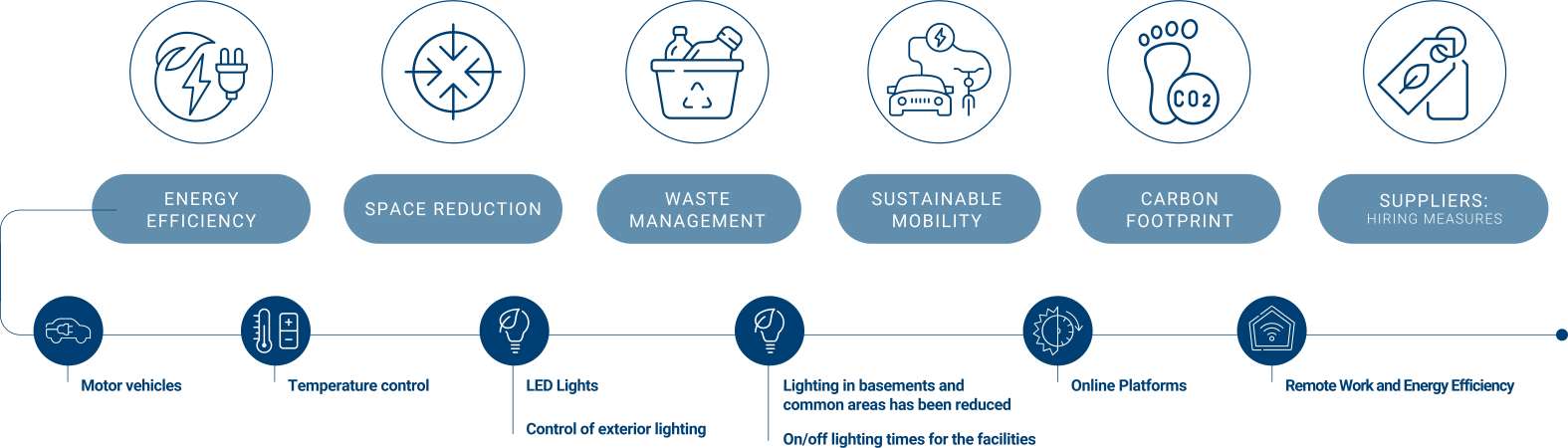
At EFE, we are committed to developing measures to improve environmental conditions. One of them is implementing energy-saving and efficiency measures. In response to the requirements of Royal Decree 56/2016 of February 12, which transposes Directive 2012/27/EU of the European Parliament and the Council of October 25, 2012, on energy efficiency concerning energy audits, an analysis of EFE's national infrastructure has been carried out.
The following measures have been implemented at our facilities to promote energy savings:
At the central headquarters, the reduction of occupied spaces continues, with a space reduction project being developed for the coming years.
A space reduction plan has been initiated in the national delegations, affecting
the delegations in Seville, Barcelona, and Bilbao, where the space occupied by EFE will be reduced.
The installation of 16 electric charging points in the garage of EFE's central headquarters has been approved, promoting electric mobility among its employees.
The policy of promoting the use of trains over planes is maintained for travel, resulting in reduced environmental pollution.
Candidates from outside Spain who apply for a position are not required
to travel for the selection process, reducing the use of planes, which is the usual method for these journeys.
In 2023, emissions for the year 2022 were calculated at the central headquarters and national delegations.
The greenhouse gases generated in 2022 were audited and verified by AENOR, totaling 752.25 tCO2 eq. The calculation for 2023 is currently underway.
In 2023, the electricity supply for the central headquarters and national delegations was tendered with a guarantee of renewable origin, resulting in a significant reduction in the carbon footprint.
The policy of replacing conventional lighting with LED lights has been maintained, resulting in significant energy savings. In various work centers, conventional lights have been progressively replaced with LED lights, leading to considerable energy savings.
The lighting in the delegations of Las Palmas and Valencia and the 5th and 9th floors of the central headquarters has been replaced with LED lights.
From the outset, it implemented remote work as a health measure against the COVID-19 pandemic
to reduce the energy impact of commuting to the workplace. This reduced building space (closing floors) and, consequently, reduced energy consumption (lighting, air conditioning, and equipment).
In 2023, electricity consumption was reduced by 6.11% at the central headquarters and 8.43% at the national delegations.