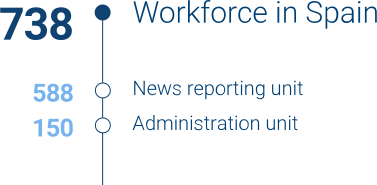
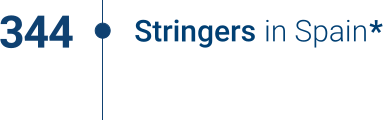
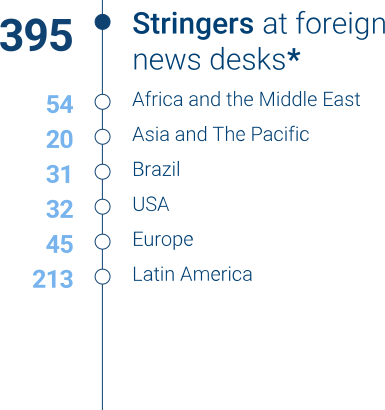
EFE is a public company committed to employment stability (in Spain, 97.56% of contracts are permanent, and almost all are full-time). The agency promotes a quality work environment and fosters its team’s personal and professional development, favoring the reconciliation of professional and personal life.
It is present throughout the national territory and has a network of 16 delegations, 5 sub-delegations, and 10 permanent offices. Additionally, it has an extensive international network of 49 delegations/offices abroad, most of which are in the Americas, with the rest located in Europe, Africa, and Asia. People are the main asset of the company.
We are the world’s leading Spanish-language news agency, with a great multicultural and generational diversity. Our professionals of 60 different nationalities add value to our news service. Our people around the world represent a third of the workforce.
Gender Equality. In October 2023, an agreement was reached on the text in the Negotiating Committee for the Equality Plan, which was adapted to legislative changes and based on the conclusions of the pay audit. This plan includes a new “Protocol for the Prevention and Action Against Sexual Harassment, Gender-based Harassment, and Moral or Psychological Harassment.” The objective is to eradicate behaviors and organizational factors that indicate workplace, sexual, and/or gender-based harassment, sexual freedom, moral integrity, or any form of workplace discrimination.
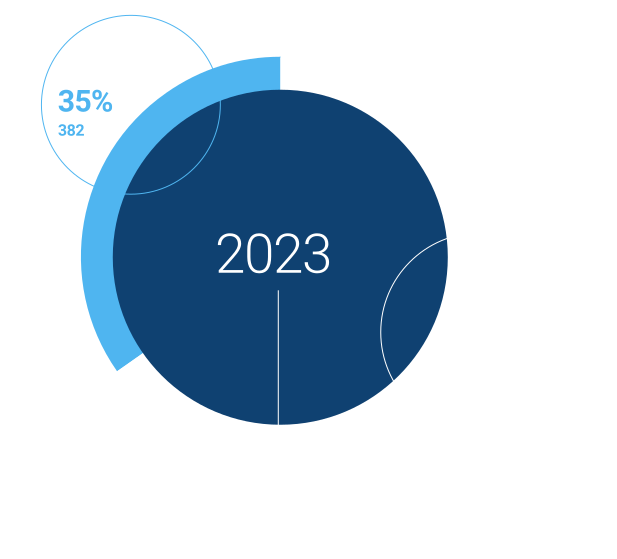
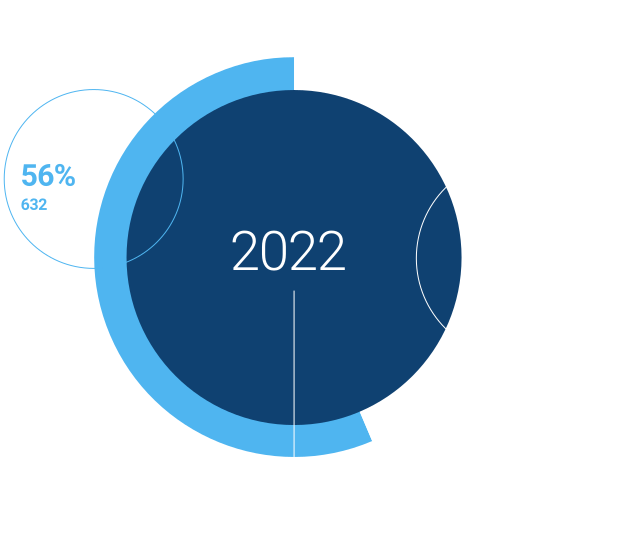
In EFE‘s workforce, women represent 44%, close to parity in a sector of activity in which the presence of the male gender is significantly higher. With regard to positions of responsibility, EFE continues to make progress towards parity. 43% of EFE‘s delegate positions abroad were held by women, and in the national delegations, women represent 44%. In the case of management positions in the central services of the corporate headquarters, it is 44%. There is a deficit of female employment in functional areas within the company, specifically in technology (11%), general services (42%), and sports (12%). On the contrary, there is a higher representation in other functional areas, specifically in National (62%), Documentation (69%), and Economy (62%).
Spain International
Women Men
Agencia EFE encourages its employees to participate in online courses, thus avoiding the need to travel from their residences to the training facilities. This reduces the use of transportation and consequently lowers the generation of greenhouse gases.
The process of unifying cellphone usage has been completed, allowing greater flexibility. A Global Corporate Directory has been implemented in the companies’ cell phones, enabling speedy access to all corporate telephones.
The King of Spain International Journalism Awards celebrated their 40th anniversary in 2023. This event commemorated forty years of EFE‘s commitment to the purest and most daring journalism and highlighted the transformation, development, concerns, evolution, and advancements of the Ibero-American community.
Created by EFE and the Spanish Agency for International Cooperation Development (AECID), these awards recognize the informative work of Spanish and Portuguese-speaking journalists from the countries that comprise the Ibero-American Community of Nations and those with which Spain keeps historical ties and cultural and cooperation relationships. These awards cover a cultural and geographical space that spans all continents, promoting the highest quality of journalism in Ibero-America.
The awards recognize stories of journalistic excellence expressed through writing, images, or sound that raise social awareness, contribute to societal education, safeguard human rights, and uphold democratic values. They also honor works related to the environment and sustainability—essential for the planet’s survival and the evolution toward inclusive development—and works related to culture, which promote citizen participation, innovation, and social cohesion, all contributing to a better world.
The awards are a benchmark in Ibero-American journalism. The laureates receive a prize of €10,000 for each of the six categories, equivalent to the Pulitzer Prize, and a sculpture by artist Joaquín Vaquero Turcios. This sculpture represents the flag of the Ibero-American Community of Nations flag, symbolizing the Iberian peoples’ cultural union with America. The artist, who passed away in 2010, was inspired by the wind as an ally, sails as instruments, and the flag as a symbol to reach the Americas.
In 2023, to mark the 40th anniversary of the awards, EFE, in collaboration with National Heritage, organized a commemorative exhibition in Madrid showcasing award-winning photographs over the past 40 years.
The exhibition “The Best of Ibero-American Journalism” was displayed in the Campo del Moro Gardens for a month and attracted over 23,000 visitors
On May 27, 2023, EFE published a report by Carmen Martín titled:
“The Best of Ibero-American Journalism, Fragments of a Powerful Mirror of Society.”
With a curious, serene, and critical eye, photographers like Sebastião Salgado, Gervasio Sánchez, and Márcia Foletto have captured stories that have helped raise social awareness and defend human rights, now featured in the exhibition “The Best of Ibero-American Photojournalism,” organized by EFE .
“Photojournalism, documentary photography, is essential and has never ceased to exist because photography is the mirror of society, and society sees itself through these images,” explains the renowned photographer Sebastião Salgado in an interview for the exhibition, which opened on June 1 in the Campo del Moro Gardens in Madrid.
The Brazilian photojournalist asserts that “photographers are perhaps the main part of the information system in the world: they go to places where people don’t have the opportunity to go, providing representative snapshots of a society we are a part of.”
Salgado won the King of Spain International Journalism Award in 1987 for his images of workers in the gold mines of Serra Pelada. These images are also included in the exhibition celebrating the 40th anniversary of these prestigious awards granted by EFE and AECID (Spanish Agency for International Development Cooperation).
There is no comprehensive way to understand recent history without seeing other images on display, such as the one by Argentine Rafael Calviño, “The Photographer Shot First” (1988). It captures the moment when positioned in the center of a car, he sees a young man pointing a gun at them.
“I took the photo. I don’t know if he realizes it or what, but he lowers the gun, and I try to get out through the back of the car. You don’t feel fear or anything at all in those seconds,” Calviño recounts.
“The Best of Ibero-American Photojournalism” includes 42 snapshots that have marked the recent history of regions, cities, towns, communities, and villages through the lives of their inhabitants.
This journey, spanning from 1983 to the present, features events that have made history, such as the arrest of Diego Armando Maradona in a drug raid by Daniel Santiago Luna (Argentina) or the murder of cameraman Carlos José Grullón González, captured by Raudo Cruz (Dominican Republic).
The collective memory still holds the image of an Indian woman from the Guajá tribe breastfeeding a wild boar piglet, captured by Pisco del Gaiso (Brazil), or the meeting between presidents George W. Bush (USA) and Alejandro Toledo (Peru), who seem to be dancing during Bush’s visit to the Andean country, captured by María Inés Menacho Ortega (Peru).
Also iconic is the image by Wilton de Sousa Júnior (Brazil) in which former Brazilian president Dilma Rousseff appears to be “stabbed in the back,” as the photographer describes it. The photographer used his military knowledge to capture the award-winning photo in 2011.
The exhibition also includes photographs highlighting child exploitation, such as those by Fernando Moleres titled “The Slaves of the End of the Century,” or the image of a woman holding her son’s shot body, captured by Marcelo Carnaval Valporto de Almeida (Brazil).Colombian photographer Manuel Salvador Saldarriaga Quintero has won this award three times for his work focused on children.
The first was in 2009 for “Innocence Amid Coca,” depicting the lives of children in coca plantations. “What impressed me most about the children living in the coca world is that they do so naturally, without knowledge; they live day to day and are happy, but when they grow up, they will see the reality and harm of those crops,” Saldarriaga laments.
His second award, in 2019, was for the project “Student Life in the El Guamo Community,” which showcased the obstacles Indigenous children face in attending school. “I wanted to show how children want to get ahead despite the violence,” explains Saldarriaga, who says his greatest satisfaction is “capturing their smiles.”
In the same vein, Márcia Foletto (Brazil) created a series on poverty in Rio de Janeiro, “Os miseráveis” (The Miserable). One of these photos, showing siblings Diana and Adriel doing their homework on the edge of a bed, was awarded in 2015.
“My intention was to provoke something in people, in society, and for these images to contribute to some kind of positive transformation,” Foletto explains.
Gervasio Sánchez (Spain) was also awarded in 2008 for a snapshot from the series “Mined Lives. Ten Years Later,” depicting the plight of people mutilated by landmines.
Another notable photograph is by Spanish photographer Pedro Armestre, awarded in 2013 for an image of the San Fermín festival. “I felt that all the photos of San Fermín were fleeting; I wanted to capture something lasting, a postcard that wouldn’t disappear with the speed of the media,” Armestre says.
The exhibition, open until July 13 and held with the collaboration of National Heritage, concludes with the series “Risking Life Crossing the Darién Gap” by 2023 award winner Manuel Salvador Saldarriaga Quintero (Colombia).
In 2023, EFE continued contributing tangible and intangible values to society through its Corporate Social Responsibility efforts.
Just before Christmas, EFE organized a “kilo operation,” in person and online, demonstrating the company’s solidarity. The Food Bank expressed its gratitude.
To contribute to environmental improvement, the General Services / Prevention Service department replaced conventional lighting with LED lights, removed 181.24 kg of “Hazardous Waste” and 11 kg of “Non-Hazardous Waste” through authorized managers, and promoted waste separation with differentiated containers for paper, packaging, and organic waste.
Additionally, EFE ‘s thematic portals on equality (Efeminista), the environment (EFE Verde), health (EFE Salud), and verification (EFE Verifica) have raised awareness, educated, included, and disseminated information. This has helped steer the agency’s activities in a sustainable and ethical direction, benefiting society as a whole.